Thursday, 7 April 2016

Birding in the Cadiz province march-april 2016

Birdwatching from Dos Mares
We had the annual "spring tour" to Southern Andalucia, both too enjoy some migration over El Estrecho, but also to travel to new places in the Cadiz Province. However, we stayed in the Tarifa area, testing out several overnight possibilities, But as always, we concluded with: Hotel Dos Mares, with a sea view, is the real thing.

Coastal area of Tarifa, along the Colado de la Costa
I would not say it was an impressive migration these days. One day, while walking the newly opened route from Tarifa and west towards Algeciras, we had about 80 Booted Eagles coming in quite low over the sea. In addition, the call from Beeaters could be heard all along the route. 

There were also a good variety of breeders or stranded migrants here, like Iberian Chifchaff, Woodchat Shrike and Black-eared Wheatear.

We had several day trips out of Tarifa. One up to the Chipiona-Sanlucar-La Algaida area. Algaida forest is a very nice area. You can drive through, but I would say a walk along the paths is a good alternative, 

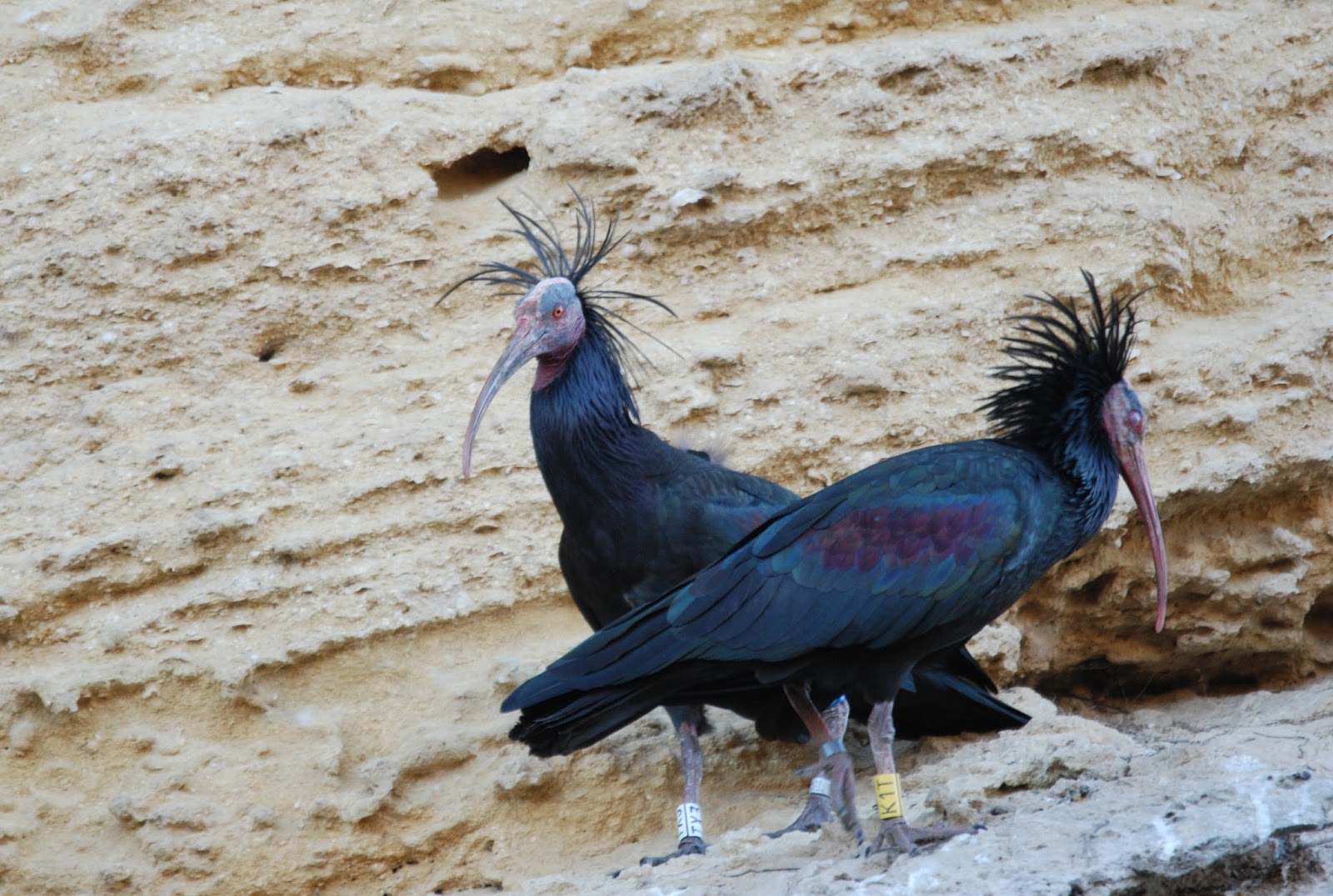
Bald Ibis at breeding site
Another trip we had was up to the Ojen Valley. I drove through here some 20 years ago, and it is still doable, but you need to take care. The road can be challenging, so also here a walk along the road could be an alternative. Last, but not least, we drove up to Arcos de la Frontera, one of the Pueblas Blancas, A nice place, but still, I would recommend Vejer de la Frontera. Another reason for going to Vejer, is of course the nearby colony of Bald Ibis. The only breeding place in Europe!

A couple of other things from the trip should also be mentioned. For the first time, we visited the roman ruins at Bolonia. A nice place, worth a visit. From here we also drove up to the Sierra de la Plata, and stayed under the Cueva del Moro for a while to see whether there were any swifts. Both White-rumped and Little Swift have bred here, but it was anyway to early for the first mentioned. Last, but not least, we enjoyed some good Black Kite migration the last day near Punta Carnero, where flocks came in low over the sea, in western gale and drizzle!
Black Kite at Punta Carnero, 4th of April, 2016

More pictures from the trip herehttps://goo.gl/photos/8pcuZpvAuYjd6kfD6

Sunday, 8 November 2015

Andalucia has everything

Andalucia is the southern most region of Spain, and one of the regions I have been visiting most. But it is a big region, divided into 8 provinces, so you really need time to do Andalucia properly. Andalucia has really as mentioned above, everything; the coast (Costa del Sol, Costa de la Luz), the mountains (Sierra Nevada, Grazalema, Ronda, Cazorla), the cities like Sevilla, Cordoba and Granada. It gives a unique possibility to combine nature, culture and relaxation. It is therefore not possible to give a just presentation on a blog. Let me then just pick a few areas that I enjoy very much and with a birdwatchingperspective.

Coto Donana

Center of El Rocio. Foto: Per S
El Rocio is the centre of Donana, and where most people stay when here. This is a spectacular village with sandy roads, white houses and really giving a "mexican" feeling. If a birdwatcher, see if you can get a hotel with a with over the lagun Charco de la Boca. And, check the calendar before you go to avoid any fiesta in the village.

If you would like to enjoy Coto Donana, you should primarily hire a guide. You need local knowledge and a four-wheel drive. If you are an ordinary tourist, you could just buy into any of the four-hour tours going from El Acebuche. But if a birdwatcher or a person who would like to see the area properly,stay away from that.
Typical Donana landscape. Foto: Per S
When should you go to Donana? Well, I have been here three times; march, april and may. In early march you will still have many winter residents in combination with early summer migrants. In april and may, the wintering birds are gone, but you have most of the breeding species there, in combintion with birds on migration. I think you can go almost at every time and enjoy it, but the drought and summer heat going on long into october should probably be avoided. And, finally, there is a huge difference whether there is water or not. I have seen both drought and floodings here, When really flooded, birds are spread and access to the park proper is difficult. If drought, waterbirds are gone. So check this in advance.

Red-knobbed Coot, Coto Donana. Foto: Per S.
So what species to focus on? Again, it depends on the season. What most people would like to see is of course the Spanish Imperial Eagle. I have not had it here, so I would say that it might be easier in Extremadura. If you have a guide however, they always know about some nests, so they would bring you in the hunting area of the birds. Another star of the area is the Red-knobbed Coot. At least for some years ago, this was the only place on the European continent you could have it, but nowadays this species is re-introduced in many wetlands in Spain.
Dehesa de Abajo in the outskirts of Donana is a place you should go; there are white stork- and black kite colonies here. Foto: Per S.


El Rocio with the Chrarco in front. One of my favourite places in Spain!. Foto: Per S.

Wednesday, 4 November 2015

Birding in the province of Cadiz early september 2015

A friend of mine and myself had a four day trip for birdwatching in the Cadiz province. We hired car in Malaga and drove to the Tarifa area where we stayed at La Codorniz (The quail), where I have stayed several times before. Tarifa, the southern most tip of Europe, as such is nothing I would recommend for people seeking tranquility or cultural highlights. But the feeling of being close to Africa, the beaches and of course the bird migration makes it a hot spot for me. 
Raptor watching at Cazalla, Tarifa.

In addition to El Estrecho- Gibraltar, we had several day trips to other places in the province. One day we went all the way up to Sanlucar de Barrameda, situated at the southern bank of Rio Guadalquivir-the spine or nerve of Andalucia. We also went up to one of the casas blancas; Vejer de la Frontera. This white village situated on the top of the hill is always a nice place to visit. And, even better, down below at La Barca de Vejer, you now would find a breeding site for the very endangered Bald Ibis!

A trip to the Strait of Gibraltar this time of the year for a birdwatcher will however have one main reason; to enjoy the raptor and stork migration from Europe to Africa. 10ns of thousands of these species, migrating during the day and therefore highly visible, are flying over the about 15 km to Morocco before they then continue deep into the African continent. We had many Honey buzzards, Short-toed and Booted Eagles, Black- and White Storks. 
Estuary of Rio Guadalquivir at Sanlucar.
 Coto Donana on the other side

Some 30 min north of Tarifa, you will find the former wetland of La Janda, where many migrants rest before they take to the wings and fly south. All though not a wetland anymore- it was drained in the 60s, the channels and also some of the rice fields had quite a lot of water this september. Quite extraordinary, taking into account is has not rained for many months. We had one of the key species there, the Black-winged Kite and we also had many Montague's harriers.
Glossy Ibises at La Janda

It satyed very warm when we were there. For birding, it would have been better with colder conditions. We had a real shower though, when we were up in the Alcornocales searching for the White-rumped Swift. We did not find it this time either, but it just inspires to go back again for it and the many other birds to be found in this rather remote and different place of Europe.

If you would like to read more about this area, try the excellent website of Birding the Strait

Monday, 2 November 2015

Birding Aragon steppees and the Pyrenees

Aragon and the Pyrenees in May 2015

El Planeron on the steppes of Aragon. Foto: Odd Kindberg.
I was acting as a guide for a group of 12 Norwegians travelling with NOF Travel to the aragonese plains and the Pyrenees. We cooperated with Josele Saiz at Boletas Birwdwatching Centre. Josele is highly recommended if you need professional guiding in this part of Spain.

A good point of departure when going to Aragon and the high-Pyrenees is Barcelona. I have taken this route several times. By doing that, you can visit the steppes of Aragon, you can see Zaragoza and then head north for Los Pirineos. And, of course stay a day or two in Barcelona- and if you are very keen drive down to the Ebro Delta as well.

The aragonese part of the Pyrenees, perhaps together with the eastern part of Navarra, is the most interesting as for birding in the mountain range. On this tour we concentrated on steppe birding in the Belchite- El Planeron area, birding in the lower Pyrenees and finally up in the higher areas for some of the key species there. On the steppes, we got the key species like Dupont's Lark, Pin-tailed Sandgrouse and even a Great Bustard- one of the few remaining here.
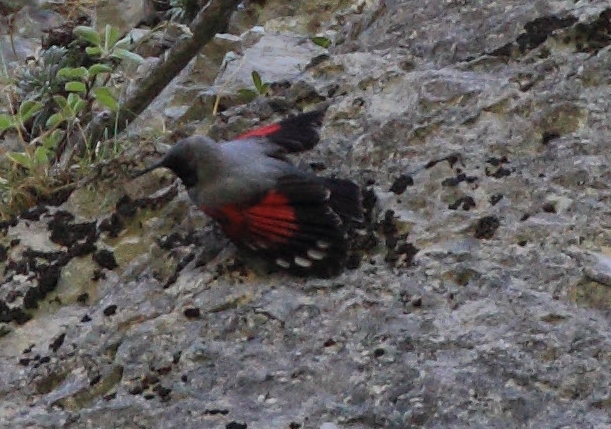
Yes, we found the Wallcreeper! Foto: Odd Kindberg 
In the Pyrenees, we stayed in the small town of Siresa, an excellent choice. It is situated in the Hecho Valley, where you can drive all the way up to Selva de Oza and also easy access up to Gabardito. As one of the star birds of the Pyrenees- the Wallcreeper no more breeds at Boca del Infierno, Gabardito is the most reliable place.

To get the one of the other star-birds of the Pyrenees, we went up the Roncal Valley, into the region of Navarra. Still into May, there were patches of snow here. We drove all the awy up to the French border, and started walking there. In this area, we had two other highlights; close contact with both Lammergeier and Alpine Accentor. The lammergeier had a marvellous show, dropping a bone to crush it on the rocks below. It was doing so several times on close range. Wow, what a show!

The lammergeier is a scavenger, a vulture, that you can find both in Asia and in Africa. But in Europe, however, they have been on the brink of extinction for decades. In Spain, they have been surviving in the Pyrenees, and they have also been re-introduced to other parts of Spain, like up in the Picos de Europa and also in Cazorla in the north-eastern corner of Andalucia. It is for sure one of the most charismatic species to be found, Huge, with up to 2,5 meter wing span, living in remote areas, often gliding along the ridges in the mountains, continously looking for dead animals or remains of it. It is the only bird that specializes in feeding on marrow, which it get's through dropping bones from the air on to rocks below.

You can see more pictures here:

Saturday, 31 October 2015

Ruta de Don Quijote and Ruta de los conquistadores

Easter in Castilla- La Mancha and Extremadura 2015

Toledo was a visit worth. Foto Per S.
My wife and I travelled in the foot steps of both Don Quijote and to the core area of the Spanish conquistadores. I have been in this area several times, but chose a slightly different route, starting in Madrid, down to Toledo, continuing through Parque National de Cabaneros, via Medellin, Merida, Trujillo and last stop at Oropesa. 

I had never been to the Cabaneros earlier, so it was nice to see it; this vast area of unspoilt dehesa with a lot of wildlife and a very good place for Spanish Imperial Eagle. The day after we went to see the village of Medellin- perhaps more known to be the drug capital of Colombia, but in fact in Spain it is the birth place of Hernan Cortes- who went to what is now called
The castle in Medellin. Foto: Per S
Mexico.We then drove through one of the most spectacular landscapes of Spain, the vast plain called La Serena. This is probably Europe's biggest steppe. The soil is not useful for farming, so it is mainly used for cattle and sheep. This means it is excellent for birdlife, with very good numbers of bustards, sandgrouses, larks, Montague's harriers and even a species like Roller. This time of the year La Serena is also covered with low and colourful vegetation. This is a must see when in this part of Spain.


La Serena, Extremadura.
After La Serena, we continued into Merida, especially known for it's roman ruins. However, during Easter this is also a very crowded and noisy city. And the Easter parade here was really something. The river Guadiana flows through here, which makes it quite good for birding, with heronries close to the city center. Anyway, of the cities of Extremadura, I like Caceres and Trujillo better.

From Plaza major, with the Pizzaro statue in Trujillo,
Extremadura.
From Merida we went to Trujillo- the birth place of Francisco Pizzaro- who conquered the Incan empire. This small and old city is a must see in Spain. It is a special atmosphere here, and also noteable is that you constantly will have White Storks, Lesser Kestrels and vultures overhead. Trujillo is also the gate from the south into Monfrague, the perhaps most known area in Extremadura for birdwatching.

Monfrague is situated along the river Tajo, and is surrounded by dehesa. It is very wild-rich and is host to a hugh number of raptors. Griffons, Egyptian and Black Vultures are common here. In addition you will find several pairs of Short-toed, Booted, Golden and Spanish Imperial Eagles. And, the good thing here is that you get very close so some of the cliffs they are breeding.
Griffon Vulture in Monfrague.


We ended our trip in Castilla La Mancha and Extremadura by staying overnight at the lovely parador in Oropesa. The parador that earlier was the house of the nobles, from where Francisco de Toledo came who was crowned as viceroy of Peru. I would really like to recommend this parador. And, from your window you will have very close contct with the Lesser kestrels breeding there.


Lesser Kestrel, Oropesa. Foto: Per S.

Tuesday, 29 September 2015

Barcelona and the Ebro delta December 2014

At Camp Nou
Our family decided to celebrate at our parents home in Alfaz del Pi, Alicante province. I departed some days ahead and arrived in Barcelona. I enjoyed Barcelona playing at home on Camp Nou, and the day after headed towards the Ebro-delta. The delta is about 200 km south of Barcelona and is by far the most important wetland on the Med Coast. I had just been there once before, on the northern side of the river. This time I has hired a guide, Jaume Soler Zorita from Audouin Birding Tours. We met in Poblenou- where I also stayed overnight and started birding. Jaume was excellent.

Plowing of rice fields make a fiesta for the egrets and herons.
What was a bit irritating was the fact that it was hunting day in the Ebro wetlands, which meant that birds were disturbed. According to Jaume hunters were allowed to hunt Coot's once a year, and that was today...Anyway, we drove out of the hunting zone and visited rice fields and wetlands bordering the sea. The rice fields were dominated by egrets and herons; Cattle Egret, Little Egret, Great White Egret and Grey Heron. Another dominating species out in the wetlands were Greater Flamingo. Together with the Laguna de Fuente Piedra in Andalucia, Delta del Ebro is the most important breeding site for this species. The delta is also the most important site for Audouin's Gull in Europe. They are common here, in addition you will find Mediterranean Gull, Slender-billed Gull, several species of terns and in winter many arctic waders wintering.
Little Egret; common in the Ebro delta
The most unusual Jaume and I had this day was anyway a Great Northern Diver (Gavia immer). It is very rare in Spain, and I had never had it before here.

The Ebro delta is a huge area which means you should stay here at least a couple of days. It is however difficult to work and easy to get lost on all the small roads and tracks. I would really recommend that you hire a guide here. As for accomodation, I stayed in Poblenou situated next to the lagunas El Clot and Tancada and alo close to the sea. For birders, I think this is an ideal staring point. Remember, there are also excellent beaches here, and you can also do sea watching for shearwaters and gannets. Next time I go here, it will be late spring when still some migration is going on and all the breeders are back.

Wetlands near the coast in the Ebro Delta

Wednesday, 30 April 2014

Andalucia march 2014

Cadiz, Grazalema and Cordoba, march 2014

Seabird watching from Hotel Dos Mares
My wife and myself had a short holiday in Andalucia, combining the coast with the interior of Andalucia. The first days we spent some days in Tarifa, at our favourite hotel, Dos Mares with view over the Atlantic. I did some raptor watching at Tarifa, in addtion to shorter trips we had to Vejer de la Frontera, Barbate and Cabo Trafalgar.

Some days later we started going north-east, going all the way up to Cordoba. I had just been driving through there earlier, so it was a new city for both of us. Cordoba is a must see, with it's history having been one of the three major cities within the Arabic empire- together
Cordoba, situated along the Guadalquivir
with Damaskus and Bagdad. The famous La Mezquita probably being on top of the list for all tourists.

I also liked how the city was situated on the bank of the Guadalquivir river. It is said to be heronries along the river, but I could not see any signs of that in march. The surroundings are more or less enormous, flat agricultural land, so the city is a bit like an oasis. But, do not go here during the summer months! This is one of the hottest places in Europe during summer, and combined with masses of tourists; no way.

Routa de Ornitologico, Grazalema
After a very nice day and night in Cordoba, we went south towards Grazalema. This mountain area is situated close to the more known Ronda, but Grazalema is more nature. I have been there twice, and I really like this small village and the mountains surrounding it. There are some big colonies of Griffon Vultures here, and can easily be seen on short range within the village. A way up in the mountains from Grazalema, there are many foot paths to choose from. I walked here in the -90-ties, but this time the fog was to heavy so we did not take the chance this time.

Last; on the way back we drove through
Ronda Gorge
Ronda. Ronda is very touristic, as it is situated so near Costa del Sol. But I have still been here off-season 3 times and have enjoyed it every time, The scenery is fantastic, both the gorge and the surroundings. And, here you can off-season find top quality hotels, where you can sit on your terrace with wonderful views, having Peregrines, Blue Rock Thrush, Rock Sparrow and Griffons on close range!