Showing posts with label Bird migration. Show all posts

Monday, 24 September 2018

Tarifa and the Strait of Gibraltar September 2018

Short trip to Tarifa 19th-22nd of September 2018

Short-toed Eagle
We had the annual autumn trip to Tarifa for raptor and stork migration. The weather was unusual hot, with prevailing Levante, meaning warm easterly winds. At times the wind was very strong, which prevented migration for many raptors. In addition the typical haze that comes with the Levante made it impossible to see the Moroccan shore at times. 

The result is that you get a lot of raptors, especially Short-toed Eagles, congregating in the Tarifa area. At one time, I had almost a hundred Short-toeds soaring together without migrating. At times they get very low when coming in from the sea after having failed to cross the strait.

Short-toed Eagles can go very low over the terrain when coming in from
 the sea after an attempt to cross
The other raptor dominating the third week of September is the Booted Eagle. They can be seen everywhere. I counted hundreds every day, however many failed the crossing and came in again so double-counts is a real problem here.

In addition to the two dominating species, there were still numbers of Black Kites and Honey Buzzards, where the juveniles were most numerous among the latter. As for harriers, there were some Marsh Harriers and very few Montague's. Of them, I had one black morph. As for storks, there were only Black Storks migrating, where one flock of about 200 was impressive.

Juvenile Honey Buzzard
So where to locate yourself under the Levante? Well, the Cazalla watch point is where you get best overview, but birds tend to go high. So my advise is to drive down to the CIMA center (Fundacion Migres Center) close to the sea. Here you can have close encounters with the raptors both in autumn and in the spring. If you have westerlies, however, the Algarrobo watch point close to Algeciras is to prefer (horrible "road").

Birdwatching in Tarifa can be really hard...
We usually stay at a hotel when in Tarifa. This time we in stead rented an apartment close to the beach and the city center. This proved to be excellent. I could watch raptors in the air from the terrace and out on the sea shearwaters, gulls and terns could be watched at the same time. Given this, you can also enjoy the convenience in having refreshments nearby!


Saturday, 14 October 2017

Raptor watch Strait of Gibraltar September 2017

Raptor and stork migration


Short-toed Eagle.
We had a 5 days holiday from september 21st to sept 26th. Weather was unusually hot, with temperatures close to 30 C, a bit inland. We stayed some nights in La Alcaidesa, some 40 mins drive from Tarifa. The last nights we, as usual, stayed at Dos Mares Hotel, just outside Tarifa.

Due to easterly winds, most of the migration seemed to go at the western end of the strait, thus the watch point at Cazalla was an optimal place. However, in periods, the wind was very strong which meant that many raptors and storks did not migrate, or they returned from the sea. This given, you could have very close encounters as they returned very low over the sea. The new observation center built close to the sea, CIMA,just north of Tarifa was then a strategic place. 

Black Storks
As expected late september, there were four species dominating the air; Short-toed Eagle, Booted Eagle, Black- and White Stork. We had thousands of all these species during these days. Additionally, we had Bonelli's Eagle, Sparrow Hawks and some late Black Kites, Montague's Harriers and Honey Buzzards. I was also lucky enough to get my first sigthing of Rüppels Vulture. 

You can get weekly numbers on the  Programa Migres site here: https://www.facebook.com/FundacionMigres/


There were at times also large numbers of swallows and swifts migrating. We had a couple of really dense flocks of Alpine Swifts and Red-rumped- and Barn Swallows were constantly moving south from early morning.


We usually do some travelling around when we have our annual trips to the Strait in spring and autumn. This time we did not, but mainly stayed close to Tarifa. Of course including mandatory trips to La Janda. Tarifa is reaally and optimal place to combine holiday and birdwatching. Where else can you relax at the seaside and see thousands of raptors and storks overhead? We will be back.

More photos here: 

Video here


Thursday, 7 April 2016

Birding in the Cadiz province march-april 2016

Birdwatching from Dos Mares
We had the annual "spring tour" to Southern Andalucia, both too enjoy some migration over El Estrecho, but also to travel to new places in the Cadiz Province. However, we stayed in the Tarifa area, testing out several overnight possibilities, But as always, we concluded with: Hotel Dos Mares, with a sea view, is the real thing.

Coastal area of Tarifa, along the Colado de la Costa
I would not say it was an impressive migration these days. One day, while walking the newly opened route from Tarifa and west towards Algeciras, we had about 80 Booted Eagles coming in quite low over the sea. In addition, the call from Beeaters could be heard all along the route. 

There were also a good variety of breeders or stranded migrants here, like Iberian Chifchaff, Woodchat Shrike and Black-eared Wheatear.

We had several day trips out of Tarifa. One up to the Chipiona-Sanlucar-La Algaida area. Algaida forest is a very nice area. You can drive through, but I would say a walk along the paths is a good alternative, 

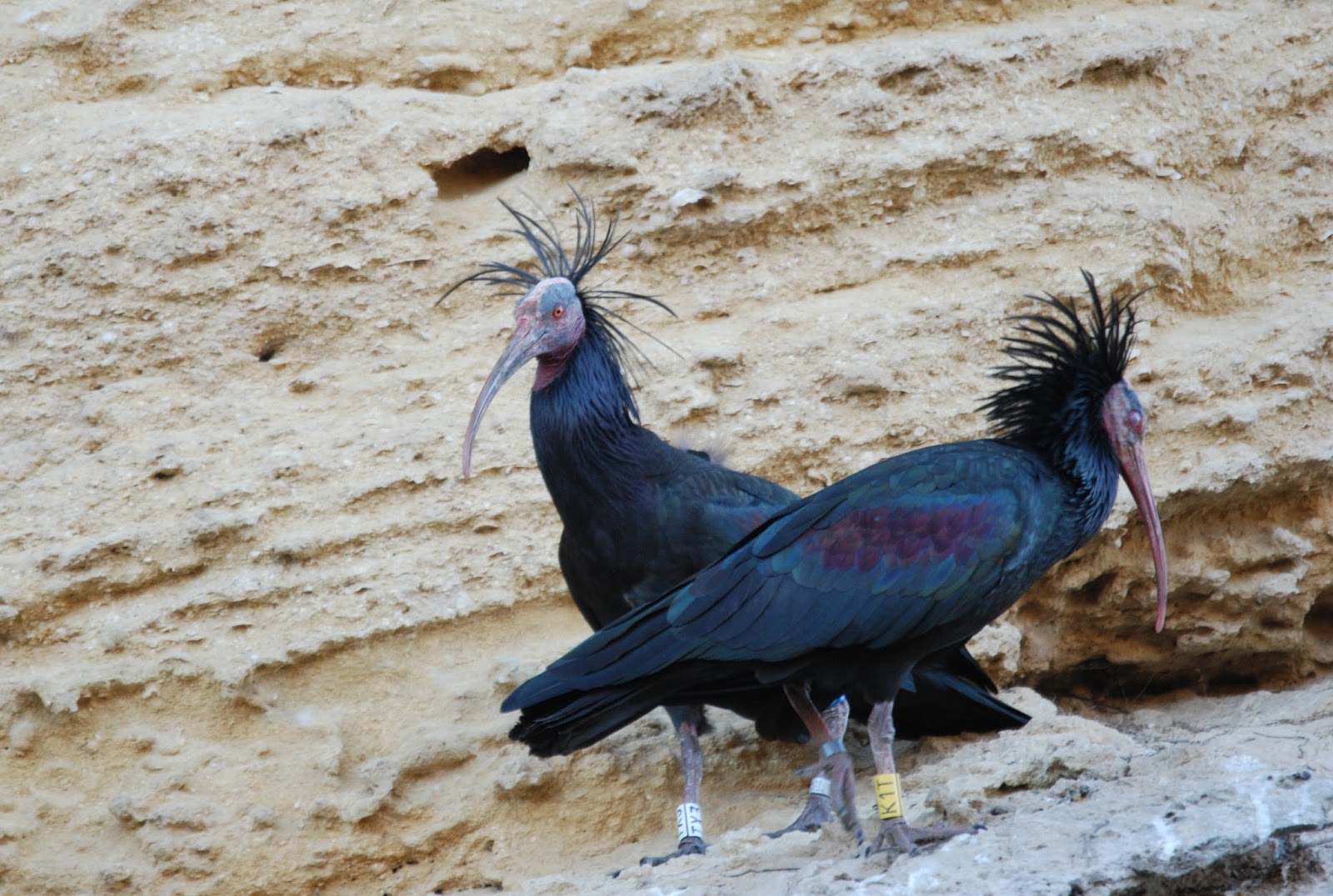
Bald Ibis at breeding site
Another trip we had was up to the Ojen Valley. I drove through here some 20 years ago, and it is still doable, but you need to take care. The road can be challenging, so also here a walk along the road could be an alternative. Last, but not least, we drove up to Arcos de la Frontera, one of the Pueblas Blancas, A nice place, but still, I would recommend Vejer de la Frontera. Another reason for going to Vejer, is of course the nearby colony of Bald Ibis. The only breeding place in Europe!

A couple of other things from the trip should also be mentioned. For the first time, we visited the roman ruins at Bolonia. A nice place, worth a visit. From here we also drove up to the Sierra de la Plata, and stayed under the Cueva del Moro for a while to see whether there were any swifts. Both White-rumped and Little Swift have bred here, but it was anyway to early for the first mentioned. Last, but not least, we enjoyed some good Black Kite migration the last day near Punta Carnero, where flocks came in low over the sea, in western gale and drizzle!
Black Kite at Punta Carnero, 4th of April, 2016

More pictures from the trip herehttps://goo.gl/photos/8pcuZpvAuYjd6kfD6

Thursday, 24 October 2013

Andalucia september 2013

NOF Travel to Southern Andalucia 18.- 23.september 2013

Raptor watch at the Mirador del Estrecho
I was a guide for a group of 12 norwegian birdwatchers, organised by NOF Travel.  We cooperated with Plegadis v/ Sergio Gonzalez Asian. We had 156 species during the 6 days we spent there. The route was about the following; We arrived at Malaga, drove down to Tarifa and spent 3 days there. We then drove north up to Laguna Medina, Brazo del Este and to La Jantejuela. On day five we visited Zaframagon and Laguna la fuente Piedra. Finally, we had the last night up in the Antequera area, before departing from Malaga again

As for raptor migration, we had a good movement on the 19th both at our stop at the Mirador del Estrecho, between Algeciras and Tarifa, and from Cazalla. About 200 Booted- and 150 Short-toed Eagles. In addition there were Black Storks, Montague's harriers and some Egyptian Vultures. Highlight was however three Spanish Imperial Eagles that we could see from Cazalla. 

Short-toed Eagle migrating towards Africa. Photo: Per S.
On the  20th we visited both the Barbate marshes and La Janda. At Barbate we had a Black-winged Kite, 5 Stone Curlews and several Caspian terns. Later in the day we had many Glossy Ibises at La Janda, the first and only Collared Pratincole of the trip and in fact also a Little Swift.

On the 21st, we started in Laguna Medina and had the usual stuff there, including Purple Swamphen and Red-knobbed Coot. Brazo del Este was however a disappointment, with about 1000 Glossy Ibises as the most remarkable. La Janteuela was however more interesting. At the dams in one of the villages we had in fact another Red-knobbed Coot, and that was the first sighting here ever! Out on the steppes we had 11 Great Bustards, 12 Black-bellied Sandgrouses and another Black-winged Kite. We stayed overnight in Montellano.

Group photo at Laguna de fuenta Piedra.
On the 22nd, we walked through Zaframagon. Lot's of Griffons, another swift with white rump, Blue Rock Thrush and 2 Bonelli's Eagles. Last day we tried the mountain near Antequera, El Torcal. A nice area, but foggy conditions made the number of species quite thin.


Wednesday, 1 April 2009

Birding Southern Andalucia march 2009

Tarifa and Coto Donana 4th- 7th of March 2009


I arrived at Tarifa in very bad and stormy conditions, and stayed overnight there. At the 5th, I drove up to Laguna Medina and then up to El Rocio. On the 6th I was together with Jose Antonio Sanchez at Discovering Donana, and we covered most of Coto Donana during the day. In the evening I drove back towards Tarifa. On the 7th I did some birding along the strait before returning home via Malaga. A short and compact trip.

Some of the observations made:

Laguna Medina

Due to all the rain, it was completely full of water. Nevertheless, I had some very good observations of about 30 White-headed Ducks, several Red-crested Pochards and Shovelers. And, 5 Black-necked Grebes.

Coto Donana

The Laguna Madre at El Rocio was full of birds and I walked along the Paseo Marismeno. Flamingoes, Glossy Ibises, Spoonbills, Little- and Great White Egrets and hundreds of Shovelers, Pintails, Teals and Wigeons. Of waders, I especially noticed the number of Black-tailed Godwits.

On the 6th. we drove directly out of El Rocio towards The Valverde Visitor Center. On the way we had 3 Great Spotted Cuckoos, Little Owl, many waders like Green Sandpipers, Greenshanks, Lapwings, Little Stints, Dunlins, Kentish and Little Ringed Plovers. Just outside the Visitor Center, we had a Red-knobbed Coot; a lifer for me!


At the center there were many Little Gulls, egrets and herons, Red-Crested Pochards and also a male Hen Harrier. From here we went east along the road towards the rice fields. Not so much here, really, but we visited the nesting area of the Spanish Imperial Eagle, and could see one bird on the nest, very distant. From here, we went up to Dehesa de Abajo. That was a very pleasant experience. Hundreds of White Storks and Black Kites breed here, and most of them seemed to be there already. Further, we had 4 Red-knobbed Coots here, huge numbers of Purple Swamphens and several White-headed Ducks. We returned to El Rocio, and I drove down to Tarifa again in the evening.

Tarifa and the Strait


At the 7th of March, I spent the day driving slowly from Tarifa towards Algeciras to see if there were raptors coming in. It turned out to be a rather good day, all though the weather was rather unstable with quite hard westerly wind, so I focused on the eastern side of the strait. It was still a constant stream of Black Kites coming in from the sea with several flocks of 100+ birds. Further, I ended with about 40 Short-toed Eagles, one Booted Eagle, a Marsh Harrier, one Peregrine, 20 Griffons and in fact a Black Vulture.