Showing posts with label Spain. Show all posts

Monday, 24 September 2018

Tarifa and the Strait of Gibraltar September 2018

Short trip to Tarifa 19th-22nd of September 2018

Short-toed Eagle
We had the annual autumn trip to Tarifa for raptor and stork migration. The weather was unusual hot, with prevailing Levante, meaning warm easterly winds. At times the wind was very strong, which prevented migration for many raptors. In addition the typical haze that comes with the Levante made it impossible to see the Moroccan shore at times. 

The result is that you get a lot of raptors, especially Short-toed Eagles, congregating in the Tarifa area. At one time, I had almost a hundred Short-toeds soaring together without migrating. At times they get very low when coming in from the sea after having failed to cross the strait.

Short-toed Eagles can go very low over the terrain when coming in from
 the sea after an attempt to cross
The other raptor dominating the third week of September is the Booted Eagle. They can be seen everywhere. I counted hundreds every day, however many failed the crossing and came in again so double-counts is a real problem here.

In addition to the two dominating species, there were still numbers of Black Kites and Honey Buzzards, where the juveniles were most numerous among the latter. As for harriers, there were some Marsh Harriers and very few Montague's. Of them, I had one black morph. As for storks, there were only Black Storks migrating, where one flock of about 200 was impressive.

Juvenile Honey Buzzard
So where to locate yourself under the Levante? Well, the Cazalla watch point is where you get best overview, but birds tend to go high. So my advise is to drive down to the CIMA center (Fundacion Migres Center) close to the sea. Here you can have close encounters with the raptors both in autumn and in the spring. If you have westerlies, however, the Algarrobo watch point close to Algeciras is to prefer (horrible "road").

Birdwatching in Tarifa can be really hard...
We usually stay at a hotel when in Tarifa. This time we in stead rented an apartment close to the beach and the city center. This proved to be excellent. I could watch raptors in the air from the terrace and out on the sea shearwaters, gulls and terns could be watched at the same time. Given this, you can also enjoy the convenience in having refreshments nearby!


Monday, 25 December 2017

Birding Tarifa and the Cadiz Province, December 2017

Winter break in Southern Spain, 9th to 13th of December, 2018

I had a short break before Christmas, and what better to do than go to the Tarifa area, as so many times before. I stayed at the Hotel Dos Mares, also as many times before. The view from the front line bungalows there are simply stunning.

On Sunday the 10th, I had agreed with Yeray Seminario at Birding the strait to have a half day at La Janda to look for Spanish Imperial Eagle. And it was a success. We had at least three individuals, 2 adults and 1 immature. At the site for one of the adults, we also constantly had an immature Bonneli's Eagle in view. We also had three Black Storks, four Spoonbills, three Black-winged Kites, two Hen Harriers and some Red Kites. In La Janda, also about 500 Cranes, 300 Golden Plovers and quite a lot of other waders were wintering. In the evening, I walked along Los Lances, and had a nice flock of 17 Audouins Gulls.


On Monday, it was quite stormy with rain, so I did some property search in stead. I managed a short visit to Palmones estuary, though. 1 Mediterranean Gull was the most interesting. On Tuesday, it had cleared up and I went up along the Costa de la Luz. First, I visited Barbate. There I had about 20 Stone Curlews and about 10 Bald Ibises. It is not far from the breeding 
site at Barca de la Vejer, so this is natural.I then drove up to Chipiona to look for Little Swifts, which in fact winter there. I had none, but a Caspian Tern and a Booted Eagle was ok. Next stop was the Bonanza Saltpans. Due to the rain the day before, I did not drive far into the area, but I drove enough to have Slender-billed Gulls and Flamingoes. Next stop was Laguna Tarelo. This is a very accessible and rewarding small lake, good in spring, autumn and winter. This time I saw Black-necked Grebe, 10 Shovelers, 15 White-headed Ducks, 40 Black-crowned Night Herons and one Little Swift.


By the way, when driving up to Chipona, I chose to go through El Puerto de Santa Maria. And there, in the middle of the round-about, with Burger King as the nearest neighbour- a replica of La Nina... what a place for this historic and world-famous Columbus ship!

On the way back, I encountered a circling flock of about 150 White Storks between Tarifa and La Janda. It might in fact have been the first arriving flock on "spring migration" as many leave Spain already in July and will start to return already in January- so why not December...?

Last day was a real mess, as I found out that I had a return ticket for 13th of February and not December..., so the best thing to do was to go to Malaga to sort things out.

More photos herehttps://photos.app.goo.gl/QX4NkaXn0jJHaOTi2


Saturday, 10 December 2016

Coto Donana december 2016

Coto Donana december 2016

Laguna de las Madres, the mother of marshes, at El Rocio.

I have been to Coto Donana several times, but never in december. Donana has always been famous as a wintering quarter for Northern European birds, so it was about time to see the importance with my own eyes. And I was lucky. The area was teeming with birds. (except for, in fact, Laguna Madre seen on the photo above...).


Little owl
The main reason for seing birds everywhere, was the heavy rain that has been pouring down for the past week. The marshes has not been so wet for 6-7 years. It also meant, however, that several of the roads in the area were not driveable or even completly blocked by masses of water. It was no problem for me. The first day I drove on the dykes of the northern marshes, from Vilmanrique de la Condesa towards Isla Mayor. The second day I was together with José Antonio Sánchez from Discovering Donana, and we were able to go into the closed area between El Rocio and the Jose Antonio Valverde center, through Coto del Rey, Hijonos, La Vera and Lucio del Lobo.

On day one, in the northern marshes, I was struck by the total number of birds, including thousands of gulls, hundreds of white storks and glossy ibises, egrets and herons and large distant flocks of ducks. I was driving along the Brazo de la Torre/Entremuros on the western dyke. However, it was not possible to get over to the rice fields on the other side; the road to Isla Mayor was blocked by water. Due to the high water level, it meant that a lot of birds were sitting along or on the dyke. I had 4-5 Black-winged kites, sitting or flying next to my car as an example.


Floaded track in the Coto del Rey pine forest
Day two- with calm, sunny and warm weather, we drove from El Rocio and east towards the Valverde visitor center. On the way we had Iberian grey shrike, Little bustards, Pin-tailed sandgrouses, Stone curlews and lots of Greylag geese, cranes and white storks. The Valverde center gave little, except for some flamingoes. However, after the coffe break going further east, It got exciting again with five Short-eared owls, a Barn owl and totally 4 Little owls. On the raptor side, there were 20 or more Lesser kestrels, two Hen harriers, a lot of Marsh harriers and a wintering Short-toed Eagle. 


Little egret
To summarize, I can really recommend going to the Donana in december. I have been there three times earlier in the spring, and one in the autumn. But to enjoy it in winter is something special. Remember that the Coto Donana partly was protected after pressure from organisations like WWF, for its importance for wintering birds from Northern Europe. Let us hope it can stay that way. One little contribution can be to be a visitor in the "low season" of december and january. It is worth it!
More photos here

Monday, 2 November 2015

Birding Aragon steppees and the Pyrenees

Aragon and the Pyrenees in May 2015

El Planeron on the steppes of Aragon. Foto: Odd Kindberg.
I was acting as a guide for a group of 12 Norwegians travelling with NOF Travel to the aragonese plains and the Pyrenees. We cooperated with Josele Saiz at Boletas Birwdwatching Centre. Josele is highly recommended if you need professional guiding in this part of Spain.

A good point of departure when going to Aragon and the high-Pyrenees is Barcelona. I have taken this route several times. By doing that, you can visit the steppes of Aragon, you can see Zaragoza and then head north for Los Pirineos. And, of course stay a day or two in Barcelona- and if you are very keen drive down to the Ebro Delta as well.

The aragonese part of the Pyrenees, perhaps together with the eastern part of Navarra, is the most interesting as for birding in the mountain range. On this tour we concentrated on steppe birding in the Belchite- El Planeron area, birding in the lower Pyrenees and finally up in the higher areas for some of the key species there. On the steppes, we got the key species like Dupont's Lark, Pin-tailed Sandgrouse and even a Great Bustard- one of the few remaining here.
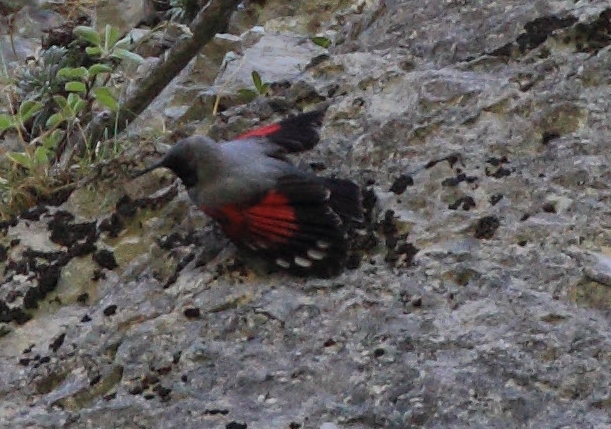
Yes, we found the Wallcreeper! Foto: Odd Kindberg 
In the Pyrenees, we stayed in the small town of Siresa, an excellent choice. It is situated in the Hecho Valley, where you can drive all the way up to Selva de Oza and also easy access up to Gabardito. As one of the star birds of the Pyrenees- the Wallcreeper no more breeds at Boca del Infierno, Gabardito is the most reliable place.

To get the one of the other star-birds of the Pyrenees, we went up the Roncal Valley, into the region of Navarra. Still into May, there were patches of snow here. We drove all the awy up to the French border, and started walking there. In this area, we had two other highlights; close contact with both Lammergeier and Alpine Accentor. The lammergeier had a marvellous show, dropping a bone to crush it on the rocks below. It was doing so several times on close range. Wow, what a show!

The lammergeier is a scavenger, a vulture, that you can find both in Asia and in Africa. But in Europe, however, they have been on the brink of extinction for decades. In Spain, they have been surviving in the Pyrenees, and they have also been re-introduced to other parts of Spain, like up in the Picos de Europa and also in Cazorla in the north-eastern corner of Andalucia. It is for sure one of the most charismatic species to be found, Huge, with up to 2,5 meter wing span, living in remote areas, often gliding along the ridges in the mountains, continously looking for dead animals or remains of it. It is the only bird that specializes in feeding on marrow, which it get's through dropping bones from the air on to rocks below.

You can see more pictures here:

Wednesday, 30 April 2014

Andalucia march 2014

Cadiz, Grazalema and Cordoba, march 2014

Seabird watching from Hotel Dos Mares
My wife and myself had a short holiday in Andalucia, combining the coast with the interior of Andalucia. The first days we spent some days in Tarifa, at our favourite hotel, Dos Mares with view over the Atlantic. I did some raptor watching at Tarifa, in addtion to shorter trips we had to Vejer de la Frontera, Barbate and Cabo Trafalgar.

Some days later we started going north-east, going all the way up to Cordoba. I had just been driving through there earlier, so it was a new city for both of us. Cordoba is a must see, with it's history having been one of the three major cities within the Arabic empire- together
Cordoba, situated along the Guadalquivir
with Damaskus and Bagdad. The famous La Mezquita probably being on top of the list for all tourists.

I also liked how the city was situated on the bank of the Guadalquivir river. It is said to be heronries along the river, but I could not see any signs of that in march. The surroundings are more or less enormous, flat agricultural land, so the city is a bit like an oasis. But, do not go here during the summer months! This is one of the hottest places in Europe during summer, and combined with masses of tourists; no way.

Routa de Ornitologico, Grazalema
After a very nice day and night in Cordoba, we went south towards Grazalema. This mountain area is situated close to the more known Ronda, but Grazalema is more nature. I have been there twice, and I really like this small village and the mountains surrounding it. There are some big colonies of Griffon Vultures here, and can easily be seen on short range within the village. A way up in the mountains from Grazalema, there are many foot paths to choose from. I walked here in the -90-ties, but this time the fog was to heavy so we did not take the chance this time.

Last; on the way back we drove through
Ronda Gorge
Ronda. Ronda is very touristic, as it is situated so near Costa del Sol. But I have still been here off-season 3 times and have enjoyed it every time, The scenery is fantastic, both the gorge and the surroundings. And, here you can off-season find top quality hotels, where you can sit on your terrace with wonderful views, having Peregrines, Blue Rock Thrush, Rock Sparrow and Griffons on close range!