Showing posts with label Las Marismas. Show all posts

Saturday, 31 March 2018

Huelva and Cadiz Provinces Easter 2018

Faro-Coto Donana-Tarifa round trip

As Faro is close to Coto Donana, we chose that airport rather than Malaga, which we always use when going to Andalucia. You will use about one hour to the Spanish border, and then you can start birding in the Huelva province straight away.

Our first stop was in El Rocio, the heart of Coto Donana. As I have been there several times before, it was quite easy to compare to previous trips. And the first impression was a rather full lagoon, with little birds. Of course, the usual stuff with flamingoes, White Storks, Glossy Ibises and Spoonbills. Of ducks, I noted Shovelers, Gadwalls and Teals.  But, it was few african migrants, meaning no warblers, pratincoles, marsh terns or Bee-eaters and few swallows and swifts. During the trip I spoke with a lot of people and all said the same thing. It is an extraordinary late spring. Some talk about a month late.
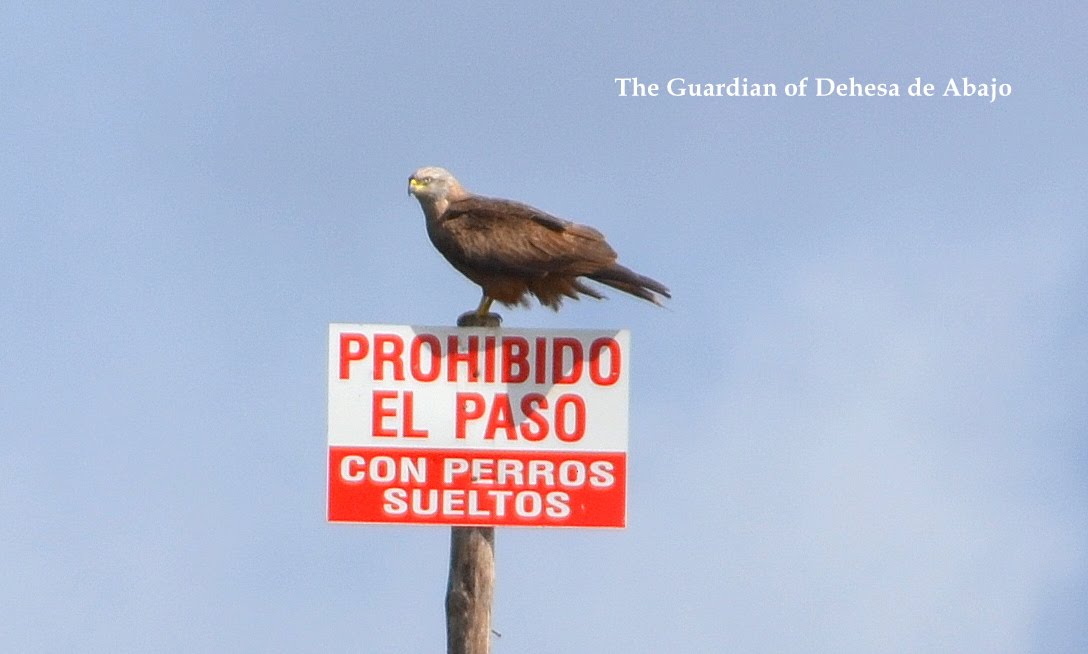
Anyway, after a night in El Rocio, we went up to Dehesa de Abajo. This is a really nice area. Perhaps a bit zoo-like, for some people, as the large populations of White Storks and Black kites breed so close and everywhere. But, that is the charm of this site. Further, the lagoon was full with water, and thus promising a good season for water birds. As it was rather windy, most of the water birds gathered on the opposite side, so identification was a bit difficult. We noted Red-crested Pochards rather close.

We then went down to Tarifa and spent three days there. As the whether had been rather poor for several weeks, I was expecting a massive migration over the Strait, since the whether now was improving. But that was not the case. Most probably, the constant north-western winds over a long periode would have halted the migration also well into Africa. Anyway, the raptor migration was going on all days. Staring a bit late, and continuing well into the evening. As the winds were mostly westerly, Punta Carnero was by far the best. Hundreds of Black Kites and Booted Eagles came in there. However also around Tarifa there was visible migration with White Storks, the occasional Black Stork, Booted Eagles, still some Short-toed and some 2-3 Montague's Harriers per days. One day up to 5 Egyptian Vultures also appeared. However, where were the hirundines, swifts and Bee-eaters?

Along Los Lances, I noted the first Northern Wheatear, Yellow Wagtails and Short-toed Larks. Also the usual masses of gulls including Audouins and Caspian Tern.

For the first time we also took a short trip to the rubbish dump at Los Barrios to look at the Black Kites and White Storks. Some say up to 2000 Black Kites have been spotted there at the same time. We had lots, but not that number...

On the detour we went back to Donana and stayed at a four star in Matalascanas. In Laguna Madre, I finally had about 15 Pratincoles, so at least some migrants were on the move. And as always, the Azure-winged Magpies in El Acebuche is worth a visit there.

At the last day, we visited an area I havent seen before, Isla Christina between Huelva and the border. The salt-pans there held the same birds as such areas everywhere; Avocets, Black-winged Stilts, Flamingoes and Slender-billed Gulls. In addition, there were some good flocks of waders, dominated by Dunlins and Common Ringed Plovers.

Some final words: Due to the whether conditions over Europe in March, a lot of rain has fallen in Southern Spain. This is very welcomed. Lagoons and marshes are quite full, and the same goes with the Embalsas. So even though the spring is late, the state of the wetlands of Andalucia gives hope for a good breeding season.

Saturday, 10 December 2016

Coto Donana december 2016

Coto Donana december 2016

Laguna de las Madres, the mother of marshes, at El Rocio.

I have been to Coto Donana several times, but never in december. Donana has always been famous as a wintering quarter for Northern European birds, so it was about time to see the importance with my own eyes. And I was lucky. The area was teeming with birds. (except for, in fact, Laguna Madre seen on the photo above...).


Little owl
The main reason for seing birds everywhere, was the heavy rain that has been pouring down for the past week. The marshes has not been so wet for 6-7 years. It also meant, however, that several of the roads in the area were not driveable or even completly blocked by masses of water. It was no problem for me. The first day I drove on the dykes of the northern marshes, from Vilmanrique de la Condesa towards Isla Mayor. The second day I was together with José Antonio Sánchez from Discovering Donana, and we were able to go into the closed area between El Rocio and the Jose Antonio Valverde center, through Coto del Rey, Hijonos, La Vera and Lucio del Lobo.

On day one, in the northern marshes, I was struck by the total number of birds, including thousands of gulls, hundreds of white storks and glossy ibises, egrets and herons and large distant flocks of ducks. I was driving along the Brazo de la Torre/Entremuros on the western dyke. However, it was not possible to get over to the rice fields on the other side; the road to Isla Mayor was blocked by water. Due to the high water level, it meant that a lot of birds were sitting along or on the dyke. I had 4-5 Black-winged kites, sitting or flying next to my car as an example.


Floaded track in the Coto del Rey pine forest
Day two- with calm, sunny and warm weather, we drove from El Rocio and east towards the Valverde visitor center. On the way we had Iberian grey shrike, Little bustards, Pin-tailed sandgrouses, Stone curlews and lots of Greylag geese, cranes and white storks. The Valverde center gave little, except for some flamingoes. However, after the coffe break going further east, It got exciting again with five Short-eared owls, a Barn owl and totally 4 Little owls. On the raptor side, there were 20 or more Lesser kestrels, two Hen harriers, a lot of Marsh harriers and a wintering Short-toed Eagle. 


Little egret
To summarize, I can really recommend going to the Donana in december. I have been there three times earlier in the spring, and one in the autumn. But to enjoy it in winter is something special. Remember that the Coto Donana partly was protected after pressure from organisations like WWF, for its importance for wintering birds from Northern Europe. Let us hope it can stay that way. One little contribution can be to be a visitor in the "low season" of december and january. It is worth it!
More photos here