Itinerary
14/5: Charter-trip Oslo-Alicante. Left my wife
and kids by my parents. Took the night-train from Alicante to Zaragoza. 15/5:
Hired a car in Zaragoza. Drove down to the steppe-reserve of Planeron. In the
afternoon drove up to Riglos (de Mallos). Further up to San Juan de la Pena and
to Jaca. Stayed in a hotel in Jaca. 16/5: Visit to the Citadell in Jaca. Then
up through the Hecho-Valley and up to Gabardito. In the evening I drove to
Ordesa and stayed overnight in Torla. 17/5: Walk in Parque Nacional de Ordesa.
Then started the long journey towards Madrid.
Stayed overnight at a motel not far from Guadalajara. 18/5: Visit to a
agricultural area near Alcala de Henares. Left the car at Barajas Airport, and
took the train down to Alicante.
15/5
Planeron, Riglos de Mallos, San Juan de la Pena, Jaca
 |
| El Planeron in the Ebro Valley of Aragaon |
At Planeron, I found the place overlooking the
area, mentioned in Croziers book. Here, there were signs and information on the
wildife. However, I did not find the reservoirs where the sandgrouses should
come in to drink. Later, though, I drove back towards Belchite and took a
farm-track which passed by some overgrown pools where I saw some Black-winged
stilts. Perhaps this was the place?
 |
| Mallos de Riglos |
I had around 10 Black-bellied Sandgrouses but
no Pin-tailed. I saw all the larks in the area, including Dupont’s. (lots of
Calandra’s , Lesser short-toed- and Short-toed) I could see 2-3 of the Dupont’s
larks, and a few also sung in the middle of the day! In Norway this species is
called ”Nightlark”, but this cannot be the whole truth! I also had a Stone
Curlew, some Quails and some Spectacled Warblers.
Planeron was a very interesting area, and I
would like to revisit. Perhaps a bit earlier in the morning!
I drove
north through Huesca, on the way to Jaca. I stopped near Riglos and watched the
huge cliffs. One Short-toed Eagle flew over and a couple of Booted Eagles also.
Lots of Griffons were soaring, together with app. 10 Black Kites and 5 Red
Kites. It was here I had the only Orphean Warblers on the trip.
 |
| Rock Sparrow |
I drove up to San Juan de la Pena to the
Monastery. I walked through the wood and got a stunning view over the Pyrenees.
From here I saw my first Lammergeier- but at a great distance. Here, I also had
the only Honey Buzzard. Smaller birds included Firecrest.
16/5 Jaca, Hecho Valley, Ordesa
Before
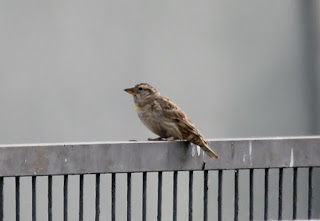
leaving Jaca, I visited the Citadell. This place is supposed to be a good site
for Rock Sparrow- and it is. Perhaps the most common species around the stone
walls!
 |
| Ordesa National Park, seen from Torla |
I drove
up through the lovely Hecho Valley. Lots of kites in these areas! First stop
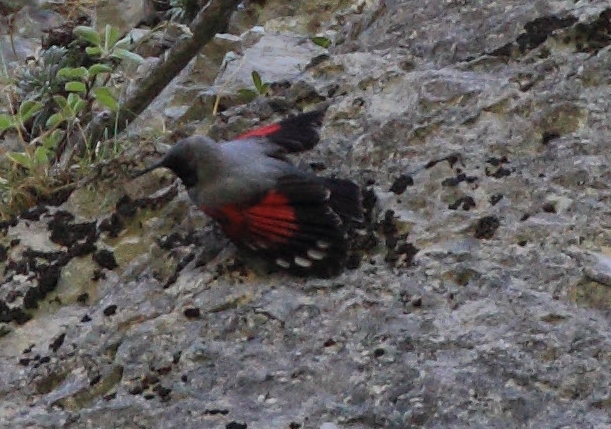
the famous Boca del Infierno- the tunnel. My aim was to get the Wallcreepers
here. Just after 15 minutes, a pair suddenly arrived. I great experience! (here
I also found a Wild Boar in the middle of the road). I then turned back and
headed for the Gabardito cross-country resort. Here again, lots of Griffons.
One or two Lammergeiers also, and a pair of Egyptian Vultures. Gabardito is
mentioned in some trip-reports to be a reliable site for Citril Finch. However,
they were not here. I walked up from Gabardito, and reached the alpine meadows.
Water pipits, and a Black Wheatear were the best on the ”small front”. However,
I found the Choughs and Alpine Choughs most interesting. Not easy to separate
in distance, but they have very different sounds. On one of the slopes I also
saw some Spanish Ibex.
I then
returned through Jaca and headed for Ordesa. Just before Jaca, I had app. 150
Griffons soaring together. The Griffon Vulture seems to be really numerous in
this area. Perhaps the highest density in Spain?
I found a hotel in Torla, and took a quick
evening trip into Ordesa. I had a Sparrowhawk, a Peregrine and a Golden Eagle
from the Information Centre. In this area, I also saw lots of species which are
more common further north in Europe, but have their stronghold in Spain here.
(tits, finches, dunnocks, thrushes, pigeons..)
17/5 Ordesa, (and drive southwards)
A bit rainy this day. I climbed the steep Senda
de las Cazadores on the right side of the river. On the way up, I found a dead
Izard/Chamois. I also had two Wallcreepers on the way up. However, I did not
make it all the way up. Because of the rain, I turned back to Torla. It then
cleared again, and from my hotel I got the best views of Lammergeier on the
trip. Two soaring together not far from the hotel, with dense flocks of
Choughs/Alpine Choughs just below. I also heard a Black Woodpecker somewhere.
 |
| Alpine Chough |
I then drove back, and drove up through the
Tena Valley and reached the high ground around the French border. A Lammergeier
here too and Alpine Choughs pretty close. I also had Blue Rock Thrush and Black
Redstarts are common here. Just around the border area I also had Marmots and a
flock of Izards.
I drove back and visited the lovely Panticosa
”village”. A Lammergeier , a Black Wheatear, and very healthy waters... Then,
the main trip was over, and I headed back. The car was to be delivered at
Barrajas, Madrid, so I had lots of miles in front of me.
18/5 In the morning, I visited the area near
Alcala de Henares, mentioned in de Juanas book. This area is supposed to hold
bustards and sandgrouses. I first visited the church in the village of Meco,
where there still are some Lesser Kestrels. Then I drove along a farm track
north of the village. I had a lovely male Montague’s Harrier and a pair of Hen
Harriers. The latter I have never seen in Spain before. But, do these areas
have bustards? If I was on the right track, I cannot see how for instance Great
Bustard can survive in such an agricultural area.
I left the car on the airport, and took the
Talgo train down to Alicante.